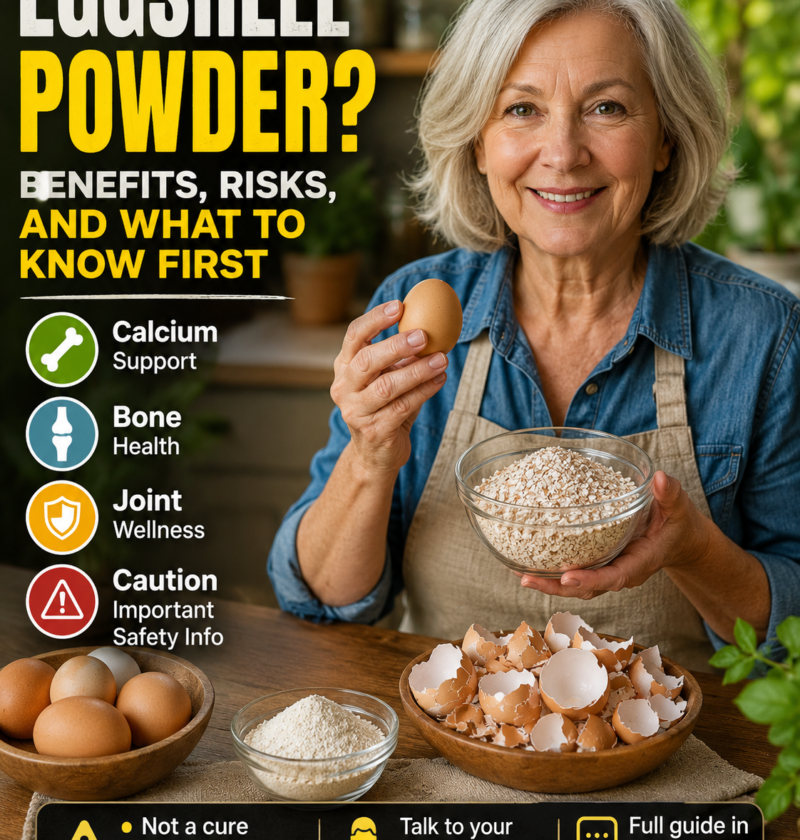
⚡ Eggshell Powder for Bone & Joint Wellness? Benefits, Risks, and What to Know First
Eggshell powder is getting attention online.
Some posts say it can support bones.
Some say it helps joints.
Others go too far and claim it is “the solution” when the knee lacks collagen.
That sounds powerful.
But it is not a safe way to explain it.
Eggshell powder may contain calcium.
Calcium is important for bones, muscles, nerves, and many body functions.
But eggshell powder is not a cure.
It does not rebuild knee cartilage.
It does not replace collagen.
It does not fix joint pain overnight.
And it may not be safe for everyone.
Before using eggshell powder as a wellness routine, there are important safety details to understand first.
🥚 Why People Are Talking About Eggshell Powder
Eggshells are mostly known as kitchen waste.
But eggshells naturally contain calcium carbonate.
Calcium carbonate is also used in many calcium supplements.
That is why some people grind clean eggshells into powder and add tiny amounts to food.
The idea is simple:
Use the shell as a low-cost calcium source.
But simple does not always mean risk-free.
Eggshell powder must be handled carefully because eggs can carry bacteria such as Salmonella. The FDA explains that even clean, uncracked eggs can contain Salmonella, which can cause foodborne illness.
That is why food safety matters a lot with this topic.
🦴 What Calcium Actually Does in the Body
Calcium is a mineral the body needs.
It helps support:
Bone structure
Teeth
Muscle function
Nerve signals
Normal blood clotting
Heart rhythm
Most calcium in the body is stored in bones and teeth.
If a person does not get enough calcium over time, bone health may be affected.
But calcium is only one part of the picture.
Bone and joint wellness also depend on:
Vitamin D
Protein
Magnesium
Exercise
Healthy body weight
Sleep
Age
Hormones
Medical history
Medication use
Overall diet
So eggshell powder should never be promoted as a complete solution.
It is not.
⚠️ Eggshell Powder Is Not a Collagen Fix
This part is very important.
Eggshell powder does not “replace collagen.”
It does not rebuild knee cartilage.
It does not cure arthritis.
It does not solve joint pain.
Eggshell powder is mainly discussed because of calcium, not collagen.
Collagen is a protein.
Calcium is a mineral.
They are not the same thing.
If someone has knee pain, swelling, stiffness, injury, arthritis symptoms, or trouble walking, they should speak with a healthcare professional.
Joint pain can have many causes.
A social media recipe cannot safely diagnose or treat it.
🧠 Common Online Claim / Safer Truth
| Common Online Claim | Safer Truth |
|---|---|
| Eggshell powder fixes knee collagen | Eggshell powder is not a collagen replacement |
| Eggshell is the solution for joint pain | Joint pain has many causes and may need medical advice |
| It rebuilds cartilage naturally | There is no safe proof that eggshell powder rebuilds cartilage |
| More calcium means stronger bones | Too much calcium can cause problems |
| Eggshell powder is safe because it is natural | Natural products can still carry bacteria or cause side effects |
| Anyone can use it daily | People with kidney issues, medication use, pregnancy, or health conditions should ask a doctor first |
| Homemade powder is always safe | Poor cleaning or storage may increase food safety risks |
🥄 Can Eggshell Powder Support Calcium Intake?
Eggshell powder may provide calcium when prepared correctly.
Some research has explored chicken eggshell as a possible way to improve calcium intake in certain settings. One review found ground eggshell may be practical and acceptable as a calcium source when handled properly, but this does not mean everyone should use homemade powder without guidance.
The big difference is control.
In research or food production, safety steps can be measured.
At home, people may not clean, heat, grind, store, or dose it correctly.
That can create problems.
A pinch is not the same as a tablespoon.
A clean supplement is not the same as random kitchen shells.
And a homemade powder does not come with a tested label.
🚫 Why Too Much Calcium Can Be a Problem
More calcium is not always better.
The body needs balance.
Too much calcium in the blood is called hypercalcemia. Mayo Clinic explains that too much calcium in the blood can weaken bones, create kidney stones, and affect the heart and brain.
This is why calcium supplements should not be used carelessly.
The NIH Office of Dietary Supplements notes that higher intakes of supplemental calcium may increase the risk of kidney stones in some people.
This does not mean calcium is bad.
It means dosing matters.
Food sources of calcium are usually safer for many people than guessing with homemade powders.
🧂 Kidney Stones and Kidney Health
People with kidney stones or kidney disease should be especially careful.
Calcium balance is connected to kidney function.
Mayo Clinic Health System advises people to talk with their healthcare team before taking calcium supplements because supplements may be linked to kidney stone risk.
Eggshell powder is not a normal food like yogurt or milk.
It acts more like a calcium supplement when used regularly.
That means people with kidney history should not use it without medical guidance.
This includes people who have:
Kidney stones
Kidney disease
High calcium levels
Parathyroid problems
Restricted mineral diets
Prescription medication affecting minerals
A doctor or pharmacist can give safer advice based on personal history.
🧼 Food Safety: The Biggest Concern With Eggshell Powder
Eggshell powder starts as an eggshell.
That means food safety is the first issue.
Eggs can carry bacteria.
Kitchen surfaces can spread bacteria.
Hands, bowls, grinders, and storage jars can also become contaminated.
The FDA recommends safe handling of eggs because Salmonella can cause foodborne illness.
If someone insists on using eggshell powder, they should understand that safety matters before grinding anything.
Unsafe preparation may lead to stomach illness.
This is especially risky for:
Young children
Older adults
Pregnant people
People with weakened immune systems
People with serious health conditions
For many people, buying a tested calcium supplement may be safer than making powder at home.
💊 Medication Interactions: Ask Before Using Regularly
Calcium can interact with some medications.
This is another reason eggshell powder should be treated carefully.
Calcium supplements can affect the absorption of certain medicines, including some thyroid medications, antibiotics, and osteoporosis medications.
People taking daily medication should ask a pharmacist before using eggshell powder regularly.
This is especially important for people taking:
Thyroid medication
Antibiotics
Osteoporosis medication
Blood pressure medication
Kidney medication
Heart medication
Daily supplements with vitamin D or calcium
Antacids containing calcium
The safest rule is simple:
If you take daily medication, ask first.
Do not guess.
🤰 Pregnancy and Breastfeeding Caution
Pregnancy and breastfeeding are not the best time to experiment with homemade powders.
Even natural products can carry risk.
Food safety is also more important during pregnancy because foodborne illness can be more serious.
Pregnant or breastfeeding people should speak with a healthcare provider before using eggshell powder, calcium supplements, or any homemade mineral routine.
Normal calcium from food is one thing.
A homemade powder is different.
🥛 Better Food Sources of Calcium
Many people do not need eggshell powder.
They may be able to get calcium from regular foods.
Common calcium sources include:
Milk
Yogurt
Cheese
Fortified plant milks
Fortified orange juice
Calcium-set tofu
Sardines with bones
Canned salmon with bones
Kale
Bok choy
Broccoli
Almonds
Beans
Fortified cereals
Food sources can be easier to manage because they come with other nutrients.
They also feel more natural in a normal meal.
For many people, adding yogurt, fortified milk, or calcium-rich foods may be simpler than using eggshell powder.
🛒 What to Look for When Buying Calcium Products
If someone wants calcium support, the safest path is usually a product with a clear label.
Look for:
Third-party testing
Clear calcium amount per serving
No extreme claims
No “joint cure” promises
No “cartilage regrowth” claims
Brand transparency
Allergen information
Medication warnings
Doctor or pharmacist advice on the label
Simple ingredients
Avoid products that say:
“Rebuilds knees fast”
“Cures arthritis”
“Replaces collagen”
“Works better than medicine”
“Doctor secret”
“Guaranteed pain relief”
These are red flags.
Good wellness products do not need fake promises.
🥚 What to Look for If Buying Eggshell Calcium Powder
Some people may find eggshell calcium products online.
If buying one, be extra careful.
Choose products that show:
Food-grade processing
Microbial testing
Heavy metal testing
Clear serving size
Calcium amount per serving
Third-party testing
Manufacturing standards
No disease claims
Clear safety warnings
A company that answers questions
Do not buy mystery powders with no label.
Do not buy products that use scary knee images and promise a cure.
Do not trust a seller who says it is safe for everyone.
No supplement is safe for everyone.
🧴 Homemade Eggshell Powder: Why It Can Be Risky
Many online recipes say to wash, boil, bake, and grind eggshells.
But the problem is consistency.
At home, people may not know:
If bacteria were fully reduced
If the grinder was clean
If the powder is stored safely
How much calcium is in one spoon
How much is too much
Whether it interacts with medication
Whether it is safe for their kidneys
Whether it is safe during pregnancy
This is why homemade eggshell powder should not be promoted as a casual daily recipe.
It is not like adding lemon to water.
It is more like making a mineral supplement at home.
That requires caution.
🦵 What Actually Supports Joint Wellness?
Joint wellness is bigger than calcium.
For many people, helpful habits may include:
Maintaining a healthy weight
Walking regularly
Strength training safely
Eating enough protein
Staying hydrated
Getting enough vitamin D
Eating colorful fruits and vegetables
Reducing highly processed foods
Managing inflammation with medical guidance when needed
Using supportive shoes
Avoiding sudden overuse
Getting joint pain evaluated if it persists
If joint pain is severe, swollen, hot, sudden, or connected to an injury, it should not be treated with online recipes.
Medical evaluation matters.
🥗 A Safer Wellness Routine
Instead of starting with eggshell powder, a safer routine may look like this:
Eat calcium-rich foods.
Get enough protein.
Spend safe time outdoors for vitamin D support.
Walk or move daily if able.
Do simple strength exercises.
Drink enough water.
Ask a doctor about vitamin D or calcium testing if concerned.
Speak with a pharmacist before supplements.
This approach is less dramatic than viral posts.
But it is much safer.
⚠️ Who Should Avoid Eggshell Powder Unless a Doctor Approves?
Avoid or ask first if you:
Have kidney disease
Have kidney stones
Have high calcium levels
Take thyroid medication
Take antibiotics
Take osteoporosis medication
Are pregnant or breastfeeding
Have egg allergy
Have a weak immune system
Have digestive disease
Take calcium or vitamin D supplements already
Have heart rhythm problems
Are on a restricted diet
For these people, homemade eggshell powder may create more risk than benefit.
✅ Final Answer: Should You Try Eggshell Powder?
Eggshell powder may contain calcium.
Calcium matters for bone health.
But eggshell powder is not a collagen fix.
It is not a joint pain cure.
It does not rebuild cartilage.
And it should not replace medical care.
The biggest concerns are food safety, dosing, kidney health, medication interactions, pregnancy caution, and false online claims.
If you are simply trying to support bones, start with a balanced diet and calcium-rich foods.
If you are considering eggshell powder or any calcium supplement, talk to a doctor or pharmacist first, especially if you take medications or have health conditions.
Natural does not always mean safe.
And viral does not always mean true.
Eggshell powder may be interesting.
But safety comes first.