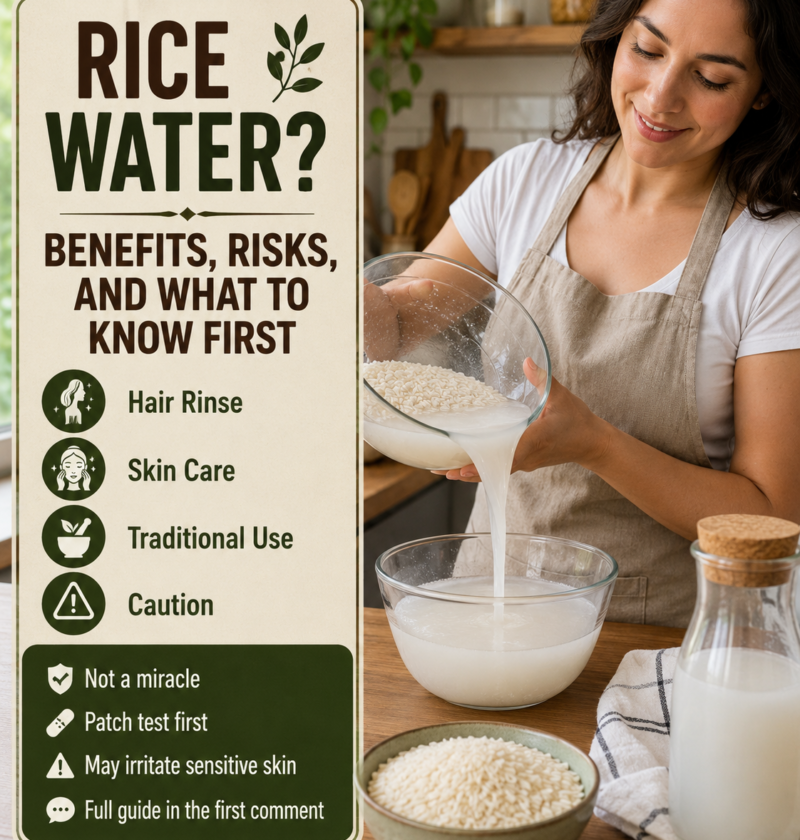
⚡ Rice Water for Skin and Hair? Benefits, Risks, and What to Know First
Rice water is going viral online.
Some posts call it “liquid gold.”
Others say almost everyone throws it away without knowing what they are losing.
It sounds simple.
You rinse rice.
You save the cloudy water.
Then you use it for hair, skin, or a beauty routine.
But is rice water really useful?
The safe answer is this:
Rice water may be a gentle traditional beauty routine for some people.
It may help hair feel smoother.
It may support a simple rinse routine.
It may feel refreshing on the skin.
But it is not a miracle.
It does not guarantee hair growth.
It does not stop hair loss.
It does not erase wrinkles.
It does not whiten skin.
And it may irritate sensitive skin or cause buildup on the scalp if used too often.
Before trying rice water, here are the benefits, risks, and what to know first.
🌾 Why Rice Water Became Popular Online
Rice water is the starchy liquid left after rinsing, soaking, or boiling rice.
It has been used in some traditional beauty routines for a long time.
Now it is popular again because it looks natural, cheap, and easy.
People use rice water as:
A hair rinse
A scalp rinse
A skin splash
A face mist
A bath ingredient
A simple DIY beauty routine
The idea feels attractive because rice is already in the kitchen.
But kitchen ingredients should still be used carefully on skin and hair.
Natural does not always mean safe for everyone.
💇♀️ Rice Water for Hair: What It May Do
Rice water may help some people’s hair feel smoother.
The starchy liquid can coat the hair temporarily.
That may make hair feel softer, thicker, or easier to manage.
Some people notice less frizz.
Some notice more shine.
Some like it as a rinse before or after shampoo.
Cleveland Clinic notes that rice water has little reason for concern for many people, but it also warns that people with scalp inflammation should avoid it because it may cause more irritation, and not rinsing it thoroughly can also irritate the scalp.
This is the safest way to explain it:
Rice water may improve the feel of hair for some people.
It does not guarantee hair growth.
It does not cure hair loss.
It should be rinsed out well.
🧴 Rice Water for Skin: What It May Do
Some people use rice water on the skin because it feels soft and light.
Rice-derived ingredients are used in some cosmetic products.
A dermatology review notes that rice-derived ingredients have been studied in skin care and are described in the literature as generally safe, non-irritating, and hypoallergenic, though this does not mean every homemade rice water routine works for every person.
That distinction matters.
A tested cosmetic product with rice extract is not the same as homemade rice water stored in a kitchen jar.
Homemade rice water can vary depending on:
The rice used
The water used
How long it soaked
Whether it fermented
How it was stored
Skin type
Hygiene
Sensitivity
So rice water may feel gentle for some people.
But it can still irritate others.
⚠️ Common Online Claim / Safer Truth
| Common Online Claim | Safer Truth |
|---|---|
| Rice water makes hair grow fast | It may improve hair feel, but it does not guarantee growth |
| Rice water stops hair loss | Hair loss has many causes and may need medical advice |
| Rice water whitens skin | Do not promote skin whitening claims |
| Rice water erases wrinkles | It may hydrate temporarily, but it does not reverse aging |
| Rice water is safe for everyone | Sensitive skin and inflamed scalps may react |
| Fermented rice water is always better | Fermentation can increase odor, irritation, and storage concerns |
| You can store it for weeks | Homemade rice water can spoil or become contaminated |
| More use means better results | Too much may cause dryness, buildup, or irritation |
🧪 What Makes Rice Water Interesting?
Rice water contains starch.
It may also contain small amounts of compounds from rice, depending on preparation.
That is why it can leave a smooth feeling on hair.
It may also feel soothing on the skin for some people.
But this does not mean rice water is a medical treatment.
It is not a proven treatment for:
Alopecia
Dandruff
Scalp infection
Eczema
Psoriasis
Acne
Hyperpigmentation
Wrinkles
Hair thinning
If someone has a real skin or hair condition, rice water should not replace professional care.
🧴 Patch Test First
Before putting rice water on your face or scalp, patch test first.
The American Academy of Dermatology says testing skin care products on small areas first can help predict whether you may have a negative skin reaction.
A simple patch test:
Apply a small amount to the inner arm or behind the ear.
Wait 24 to 48 hours.
Watch for redness, itching, burning, bumps, swelling, or rash.
Do not use it on your face or scalp if irritation appears.
Patch testing is especially important if you have:
Sensitive skin
Eczema
Acne-prone skin
Rosacea
Allergies
Scalp irritation
A history of reactions to DIY products
Patch testing does not make any product 100% safe.
But it is a smart first step.
🦠 Storage and Contamination Risk
Homemade rice water can spoil.
This is especially true if it is kept at room temperature or stored for too long.
Cosmetic safety matters because skin products can become harmful if contaminated. The FDA says cosmetic products can become harmful when contaminated with harmful microorganisms, including pathogenic bacteria and fungi.
Homemade products do not have the same preservation systems as store-bought cosmetics.
That means you should be careful.
Safer storage tips:
Make small amounts.
Use clean bowls and jars.
Keep it refrigerated.
Do not store it for many days.
Throw it away if it smells strange.
Throw it away if it changes color or texture.
Do not dip dirty fingers into it.
Do not use it near the eyes.
If in doubt, throw it out.