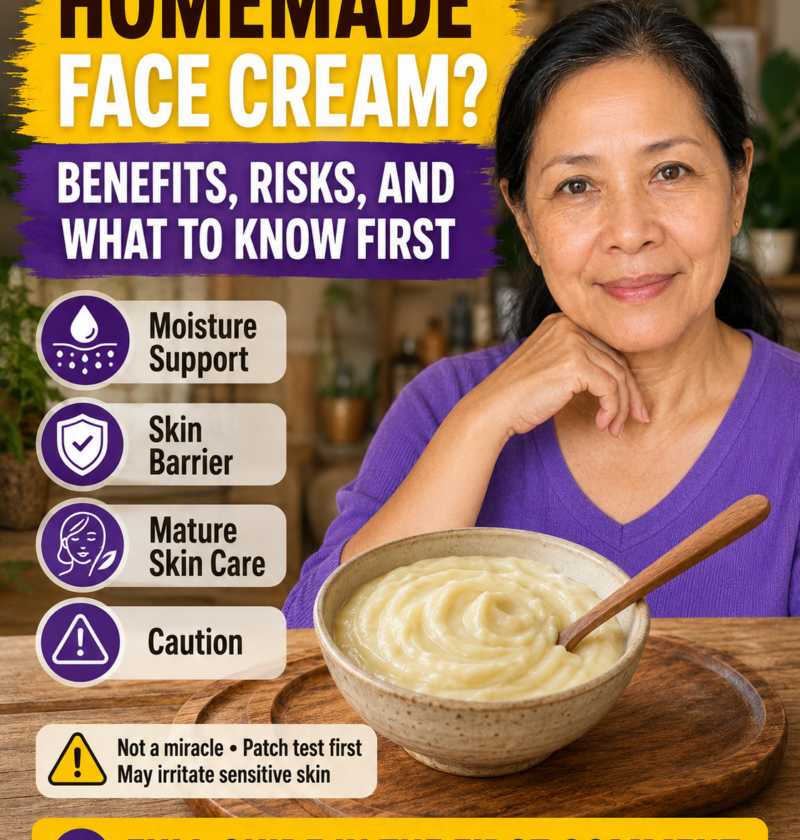
⚡ Homemade Face Cream? Benefits, Risks, and What to Know First
Homemade face cream is going viral online.
Some posts show a bowl of creamy mixture beside a woman’s face.
Then they claim it can make mature skin look decades younger, remove wrinkles, or bring back the skin of a 30-year-old.
That sounds exciting.
But it is not a safe or honest claim.
A homemade face cream may help moisturize the skin.
It may feel soothing.
It may support the skin barrier if the ingredients are gentle.
But it is not a miracle.
It cannot reverse aging overnight.
It cannot erase wrinkles permanently.
It cannot make a 60-year-old look 30.
And it may irritate sensitive skin if the wrong ingredients are used.
Before trying any homemade face cream, here are the benefits, risks, and what to know first.
🌿 Why Homemade Face Cream Became Popular
People like simple beauty routines.
A bowl of natural cream looks soft, clean, and comforting.
Ingredients like aloe vera, shea butter, coconut oil, honey, oats, yogurt, and oils are often used in DIY skin care.
Many people also want to avoid harsh products or expensive creams.
That is understandable.
But natural skin care still needs caution.
The face is sensitive.
What feels safe in the kitchen may not be safe on the skin.
And homemade products do not always contain preservatives, testing, or proper hygiene controls.
The safest way to explain homemade cream is simple:
It may help with moisture.
It may support comfort.
It may be part of a gentle routine.
But it is not anti-aging magic.
💧 The Most Realistic Benefit: Moisture Support
The most realistic benefit of a homemade face cream is moisture.
Dry skin can make fine lines look more noticeable.
When skin is moisturized, it can look softer and smoother.
That does not mean wrinkles are gone.
It means hydrated skin often looks healthier.
The American Academy of Dermatology says that moisturizers can help ease dryness and restore the skin’s protective barrier, and that creams and ointments often hold more moisture than lotions.
So a gentle cream can be useful if the goal is simple hydration.
But the promise should stay realistic.
Moisture support is not the same as age reversal.
🛡️ Skin Barrier: Why It Matters
Your skin barrier is the outer layer that helps protect your skin.
It helps keep moisture in.
It helps keep irritants out.
When the barrier is damaged, skin may feel dry, itchy, tight, red, or sensitive.
Harsh DIY ingredients can make that worse.
A good face cream should support the barrier, not attack it.
For mature skin, this matters even more.
Skin often becomes drier with age.
AAD recommends creamy, fragrance-free moisturizers for older adults and says ointments can be helpful when skin feels very dry.
That means gentle and simple is usually better than strong and complicated.
⚠️ Common Online Claim / Safer Truth
| Common Online Claim | Safer Truth |
|---|---|
| Homemade cream makes you look 30 again | No cream can reverse age like that |
| It removes wrinkles overnight | Moisture may soften the look of dryness, but it does not erase aging |
| Natural means safe | Natural ingredients can still irritate the skin |
| Lemon brightens skin safely | Lemon can irritate skin and increase sensitivity |
| Baking soda cleans the face | Baking soda can be too harsh for facial skin |
| Essential oils are safe because they are natural | Essential oils can cause irritation or allergic reactions |
| Homemade cream is always better than store-bought | Homemade products may lack preservatives and safety testing |
| Everyone can use the same recipe | Skin type, allergies, acne, eczema, and sensitivity matter |
🧴 Patch Test First
Before putting any homemade cream on your face, patch test first.
A patch test means applying a small amount to a small area of skin before using it widely.
This helps you check for irritation, redness, itching, burning, swelling, or rash.
A safer patch test routine:
Apply a tiny amount behind the ear or on the inner arm.
Wait 24 to 48 hours.
Do not use it on your face if irritation appears.
Stop immediately if burning or itching happens.
If you have eczema, allergies, acne-prone skin, or sensitive skin, ask a dermatologist first.
Patch testing does not guarantee safety, but it lowers the chance of a bad surprise.
🍋 Ingredients to Avoid on the Face
Some DIY skin care ingredients are risky.
Avoid putting these directly on your face:
Lemon juice
Baking soda
Toothpaste
Undiluted essential oils
Strong cinnamon mixtures
Garlic
Raw egg
Harsh scrubs
Hydrogen peroxide
Vinegar
Unknown powders
AAD warns that fragrance and essential oils can irritate the skin or trigger allergic rashes in face masks.
Essential oils are especially important to mention.
A review in the dermatology literature notes that many essential oils have been reported to cause contact allergy, especially in people with damaged or sensitive skin barriers.
Natural does not mean gentle.
🦠 Homemade Cream and Contamination Risk
Homemade face creams can spoil.
They can also grow bacteria or mold if water, fruit, dairy, aloe, tea, or fresh ingredients are added.
This matters because the product is going on your face.
The FDA explains that cosmetic products can become harmful if contaminated with harmful microorganisms, including pathogenic bacteria and fungi.
The FDA also notes that homemade cosmetics need attention to microbiological safety because cosmetics must not contain harmful microorganisms.
This is why homemade mixtures should not be stored for a long time.
Fresh does not always mean safe.