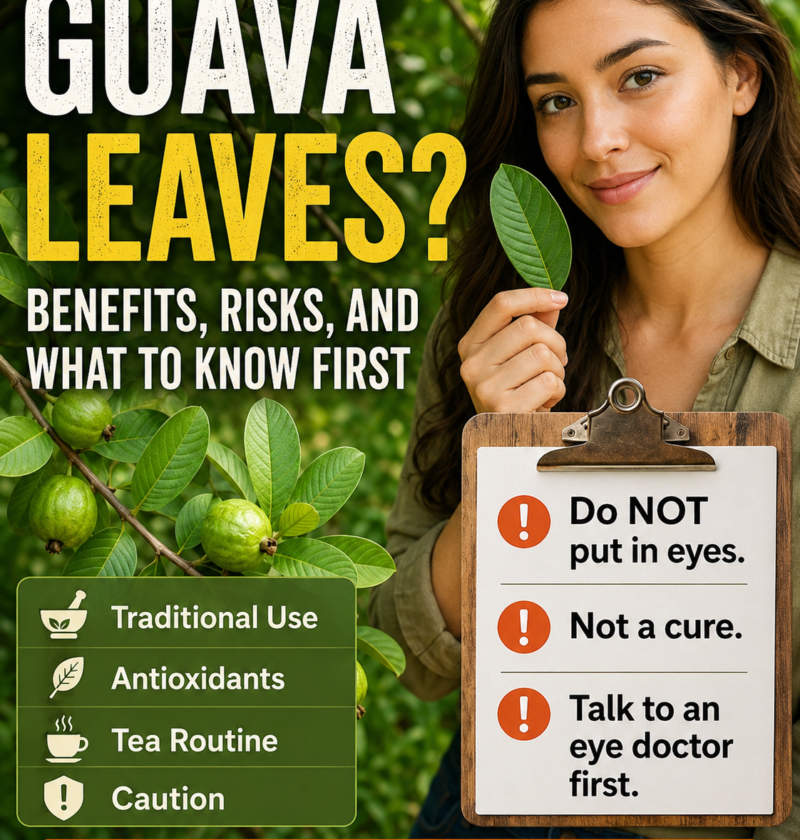
⚡ Guava Leaves and Eye Health Claims? Benefits, Risks, and What to Know First
Guava leaves are going viral online.
Some posts show guava trees, green leaves, and images of eyes.
Then they claim guava leaves can relieve eye problems, replace medication, or work as a natural remedy for vision.
That sounds simple.
But it is not safe.
Eye problems should never be treated with homemade leaf water, herbal drops, or internet recipes.
Guava leaves may be used in traditional tea routines.
They contain plant compounds and antioxidants.
Some people drink guava leaf tea as part of a wellness routine.
But guava leaves are not a cure.
They are not a treatment for eye infections, blurry vision, eye pain, redness, or serious eye disease.
And you should not put guava leaf water, tea, seed liquid, or homemade extracts in your eyes.
This guide explains the benefits, risks, and what to know first.
🌿 Why Guava Leaves Became Popular Online
Guava leaves come from the guava tree.
In many cultures, they are used traditionally as tea or in wellness routines.
Because the leaves are natural, people often assume they are harmless.
But “natural” does not always mean safe.
A leaf tea used as a drink is very different from putting liquid into the eye.
The eye is sensitive.
It can be irritated or infected easily.
Homemade liquids can contain bacteria, dust, plant particles, or chemicals from the leaf surface.
That is why this topic needs caution.
Guava leaves may be interesting as a tea.
But they should not be used as eye drops.
👁️ The Most Important Warning: Do Not Put Guava Leaves in Your Eyes
This is the main point.
Do not put guava leaf tea in your eyes.
Do not put guava seed water in your eyes.
Do not put crushed leaf juice in your eyes.
Do not rinse the eyes with homemade herbal liquid.
Do not use any “natural eye drop” unless it is approved and recommended by an eye professional.
Even real eye drops must be used correctly. Eye-drop technique guidance from the American Academy of Ophthalmology focuses on using proper sterile eye-drop products and avoiding contamination, including not touching the dropper tip to the eye.
A homemade guava leaf liquid is not sterile eye medicine.
If you have eye pain, redness, discharge, swelling, blurry vision, injury, or sudden vision changes, talk to an eye doctor.
🍵 Guava Leaf Tea: A Safer Traditional Use
The safer traditional use of guava leaves is usually tea.
People may steep clean leaves in hot water and drink it as part of a wellness routine.
Some research has explored guava leaf tea for blood sugar and lipid-related effects, but even that research discusses the possibility of interactions with diabetes medications or other drugs.
That means guava leaf tea should not be treated like a harmless daily drink for everyone.
It may be simple.
But it can still matter if someone has health conditions or takes medication.
A mild tea is very different from a strong extract, capsule, or concentrated supplement.
🧠 Common Online Claim / Safer Truth
| Common Online Claim | Safer Truth |
|---|---|
| Guava leaves relieve eye problems | Eye problems need proper eye care, not homemade leaf liquid |
| Guava leaf water replaces medication | Guava leaves should not replace prescribed treatment |
| You can put guava tea in the eyes | Do not put homemade herbal liquids in the eyes |
| Natural means safe | Natural products can still irritate or contaminate the eye |
| Guava leaves cure infection | Infections need medical diagnosis and treatment |
| Guava leaf tea is safe for everyone | Some people should ask a doctor first |
| More leaves make it stronger | Stronger may increase side effects or risks |
| A recipe online is enough | Eye symptoms should be checked by a professional |
🍃 What Guava Leaves May Offer
Guava leaves contain plant compounds such as polyphenols and flavonoids.
These compounds are often studied for antioxidant activity.
That is why guava leaves are popular in traditional wellness discussions.
But antioxidant activity does not mean a leaf cures disease.
It also does not mean it treats eye problems.
A safer way to explain guava leaves is this:
They may be used as a mild herbal tea.
They may contain plant compounds.
They may be part of a traditional wellness routine.
They should not replace medical care.
They should never be used inside the eyes.
🩸 Blood Sugar Caution
This is one of the most important safety sections.
Some studies have explored guava leaf tea and blood sugar.
That may sound interesting, but it also creates a safety concern.
If someone takes diabetes medication, a guava leaf product could possibly affect blood sugar control or interact with medication. A study review on guava leaf tea specifically notes that interactions with anti-diabetic or other drugs could pose risks such as hypoglycemia or changes in drug activity.
So the safe advice is:
Do not use guava leaf tea as a diabetes treatment.
Do not stop medication.
Do not combine it with diabetes medication without asking a doctor or pharmacist.
Blood sugar problems need professional care.
🤰 Pregnancy and Breastfeeding Caution
Guava fruit is commonly eaten as food.
Guava leaf tea, extracts, or supplements are different.
WebMD notes that guava is likely safe when eaten as food, but there is not enough reliable information to know if guava is safe to use as medicine during pregnancy or breastfeeding.
That means pregnant or breastfeeding people should stay cautious.
Food amounts are one thing.
Medicinal teas, strong extracts, powders, and capsules are another.
During pregnancy or breastfeeding, ask a healthcare professional before using guava leaf products.
🤧 Allergy and Skin Sensitivity
Some people may react to guava leaf products.
This can happen with teas, extracts, powders, or skin contact.
Possible reactions may include:
Itching
Rash
Redness
Swelling
Stomach discomfort
Mouth irritation
Skin irritation
WebMD notes that guava leaf extract may make eczema worse because it contains chemicals that can cause skin irritation, especially in people with skin conditions.
If you have eczema, sensitive skin, or plant allergies, be careful with guava leaf extracts.
Stop using it if irritation happens.
👁️ Eye Symptoms That Need a Doctor
Do not wait if eye symptoms are serious.
See an eye doctor or urgent medical care if you have:
Eye pain
Sudden blurry vision
Vision loss
Eye injury
Chemical exposure
Swelling around the eye
Thick discharge
Strong redness
Light sensitivity
A feeling that something is stuck in the eye
Symptoms after using homemade drops
Eye issues can become worse if treated incorrectly.
A homemade remedy can delay real treatment.
That delay can be dangerous.
🚫 Why “Without Chemical Medication” Is Misleading
Some viral posts say natural remedies work “without chemical medication.”
That wording is misleading.
Medication is not automatically bad.
Eye medications are made to be sterile, tested, and used for specific problems.
If someone has an eye infection, allergy, injury, glaucoma, dry eye disease, or inflammation, the right treatment depends on the cause.
A guava leaf recipe cannot safely decide that.
Natural products can also contain chemicals.
Plants are made of chemical compounds too.
So the real question is not “natural or chemical.”
The real question is:
Is it safe?
Is it sterile?
Is it tested?
Is it right for the problem?
Did an eye professional recommend it?
🛒 What to Look for When Buying Guava Leaf Tea
If you want to buy guava leaf tea for a simple wellness routine, choose carefully.
Look for:
Food-grade guava leaves
Trusted brand
Clean ingredient list
No disease claims
No eye cure claims
No “replace medicine” language
Clear brewing instructions
No mystery powders
No exaggerated testimonials
Packaging that is sealed
Organic option if preferred
Avoid products that promise:
Eye problem relief
Vision restoration
Disease cure
Diabetes cure
Infection treatment
Fast detox
Guaranteed results
Those claims are red flags.
🛍️ What to Look for When Buying Guava Leaf Supplements
Guava leaf supplements need more caution than tea.
Before buying, check:
Third-party testing
Supplement facts label
Clear dosage
Medication warnings
Pregnancy warning
Allergen information
Brand transparency
No miracle claims
No eye-drop instructions
No “natural antibiotic” promises
No “safe for everyone” language
Avoid any product that tells you to put guava extract in your eyes unless it is a properly approved medical product prescribed or recommended by an eye professional.
For most people, guava leaf tea should stay a drink, not an eye treatment.
🍵 Safer Ways to Use Guava Leaves
A safer routine looks simple.
Use guava leaves only as a mild tea.
Do not make it too strong.
Do not drink it like medicine.
Do not use it every day without thinking about your health conditions.
Do not use it with diabetes medication unless a healthcare professional approves.
Do not give strong herbal teas to children without medical advice.
And most importantly:
Do not put it in your eyes.
🚫 Mistakes to Avoid
Do not put guava leaf water in your eyes.
Do not use guava seeds for eye problems.
Do not rinse the eye with homemade tea.
Do not replace eye drops with herbal liquid.
Do not ignore red eyes or blurry vision.
Do not use guava leaf tea as diabetes medicine.
Do not drink strong guava leaf tea during pregnancy without advice.
Do not trust posts that use before-and-after eye images.
Do not believe “natural means safe.”
Do not delay medical care.
🧠 The Real Wellness Takeaway
Guava leaves may be used in traditional tea routines.
They contain plant compounds and may have antioxidant-related interest.
But they are not eye medicine.
They are not sterile.
They are not a cure.
And they should not be put in the eyes.
Eye problems need proper care.
Blood sugar concerns need professional guidance.
Pregnancy, breastfeeding, medication use, allergies, and skin conditions all require caution.
A safe wellness routine should be simple, realistic, and responsible.
✅ Final Answer: Should You Try Guava Leaves?
You may try guava leaf tea as a mild traditional drink if you tolerate it well.
But do not use guava leaves to treat eye problems.
Do not put guava tea, guava seed water, or leaf juice in your eyes.
If you have eye redness, pain, blurry vision, discharge, injury, or sudden vision changes, talk to an eye doctor.
If you take diabetes medication, are pregnant or breastfeeding, have eczema, or take daily medication, ask a doctor or pharmacist before using guava leaf tea or supplements.
Guava leaves may be interesting.
But eye safety comes first.