One Ingredient for Year-Round African Violet Blooms
African violets are among the most beloved indoor flowering plants in the world. Their velvety leaves and jewel-toned flowers bring warmth and color to homes year-round. Yet for many plant owners, blooming feels unpredictable. One month the plant is covered in flowers, and the next it produces nothing but leaves.
This cycle often leads people to search for a single secret — one ingredient that can make African violets bloom continuously. While no ingredient works alone, there is one gentle, natural supplement that can quietly support consistent blooming when everything else is already in balance.
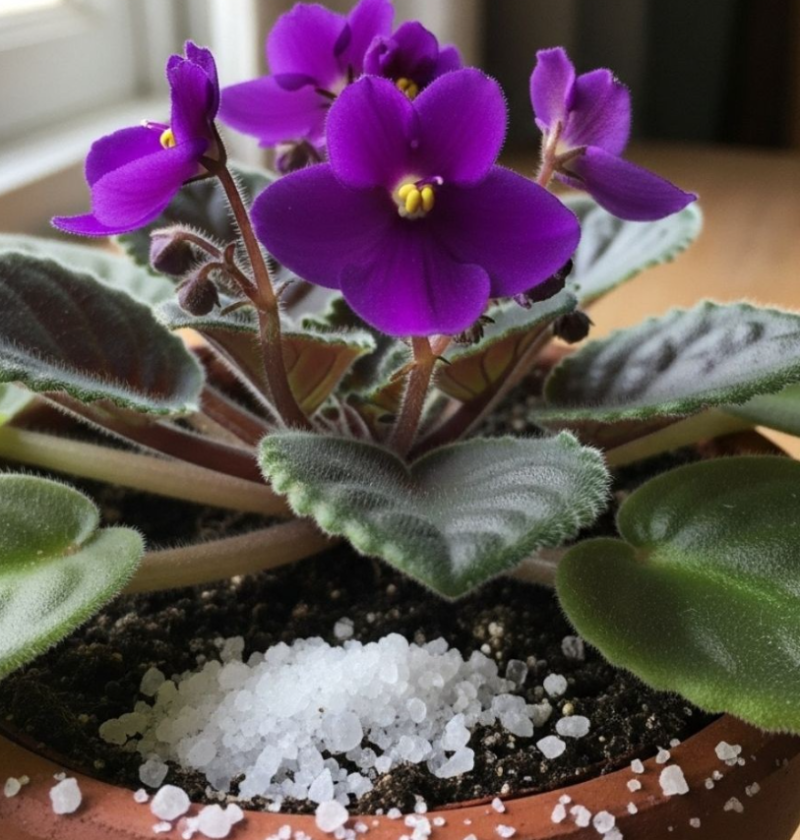
That ingredient is Epsom salt — not as a miracle cure, but as a targeted support for a common nutrient imbalance that limits flowering indoors.
This article explains how Epsom salt works, when it helps, when it does not, and how to use it safely to support healthy, year-round African violet blooms through patience and proper care.
Why African Violets Stop Blooming Indoors
African violets are sensitive plants. They respond quickly to changes in their environment, especially light, moisture, and nutrients. When blooming stops, it is rarely random.
The most common reasons include:
- Insufficient or inconsistent light
- Overwatering or underwatering
- Compacted or exhausted soil
- Root stress or overpotting
- Imbalanced nutrition
Even when a plant looks healthy, a subtle deficiency can quietly reduce its ability to form flower buds.
The One Ingredient: Why Epsom Salt Matters
Epsom salt is magnesium sulfate — a naturally occurring mineral compound. It contains no nitrogen, phosphorus, or potassium. Instead, it provides magnesium, an element many flowering plants rely on to function properly.
Magnesium plays a key role in:
- Chlorophyll production
- Energy transfer within the plant
- Efficient photosynthesis
- Flower bud development
Without enough magnesium, African violets may produce leaves but struggle to bloom consistently.
Why Magnesium Deficiency Is Common Indoors
Indoor plants live in closed systems. Over time, repeated watering flushes minerals out of the soil. Many commercial fertilizers focus on leaf growth rather than micronutrient balance.
African violets grown in peat-based mixes are especially prone to magnesium depletion, particularly when watered with soft or distilled water.
This is where Epsom salt becomes useful — not as a fertilizer, but as a targeted mineral supplement.
Signs Your African Violet May Benefit From Epsom Salt
Not every plant needs supplementation. Epsom salt is most effective when specific symptoms are present.
Common Signs
- Pale or yellowing older leaves with green veins
- Healthy leaf growth but few or no flowers
- Slower-than-usual blooming cycles
- Leaves that lack deep green color
If these signs persist despite good light and watering, magnesium may be limiting bloom production.
What Epsom Salt Will NOT Fix
It is important to set realistic expectations. Epsom salt will not compensate for poor care.
It will not:
- Replace proper lighting
- Fix root rot
- Correct severe overwatering
- Make a stressed plant bloom instantly
It works only when the basics are already in place.
How to Prepare the Correct Epsom Salt Solution
Always use pure, unscented Epsom salt with no additives.
Safe Dilution Formula
- 1 teaspoon Epsom salt
- 1 gallon (3.8 liters) room-temperature water
Stir until fully dissolved. The solution should be completely clear.
This dilution is gentle enough for African violets and safe when used occasionally.