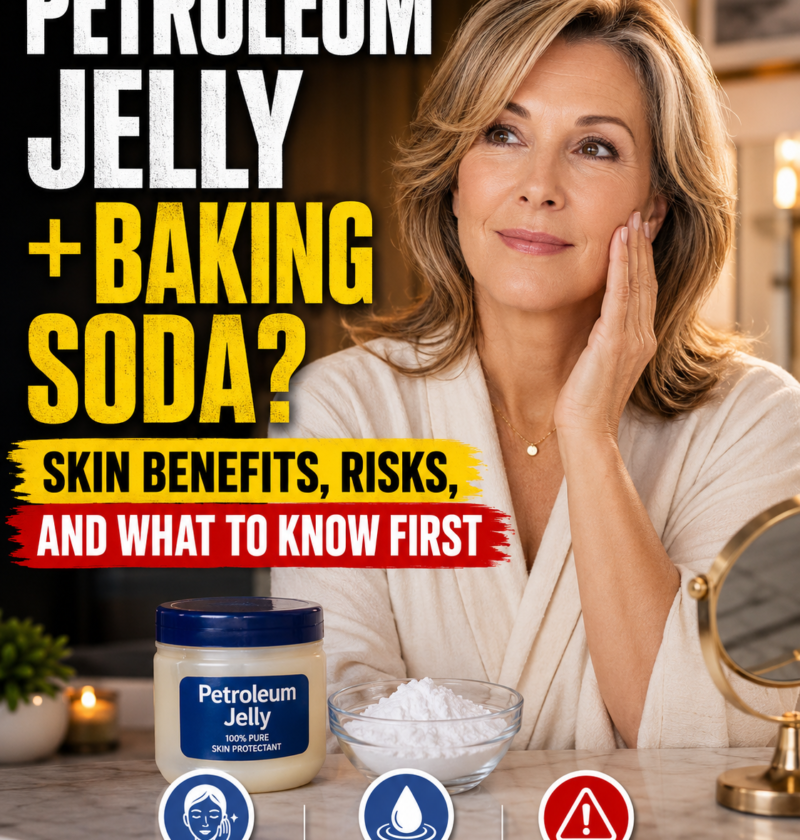
⚡ Petroleum Jelly + Baking Soda? Skin Benefits, Risks, and What to Know First
Petroleum jelly is one of the most common skincare products at home.
Baking soda is one of the most common kitchen powders.
So when people see both of them together, they often think:
Maybe this is the secret.
Maybe it can smooth the skin.
Maybe it can help wrinkles.
Maybe it can make the face look younger.
Maybe it works overnight.
At first, the idea looks simple.
One jar.
One white powder.
A quick mixture.
Apply before bed.
Wake up with smoother skin.
But facial skin is delicate.
And not every homemade mixture is safe for the face.
That is why smart people ask one question first:
Is this actually helpful, or could it irritate the skin?
🧴 Why Petroleum Jelly Is So Popular
Petroleum jelly has been used for dry skin for many years.
It is thick.
It is simple.
It helps lock moisture into the skin.
Many people use it on dry lips, cracked hands, rough elbows, and dry patches.
The American Academy of Dermatology says petroleum jelly can help relieve dry skin, including lips and eyelids, because ointments can be more effective and less irritating than lotions for very dry skin. (Académie Américaine de Dermatologie)
This is why petroleum jelly has a strong reputation.
It does not add water to the skin by itself.
Instead, it helps seal moisture in.
That can make dry skin look softer and more comfortable.
⚠️ Why Baking Soda Is Different
Baking soda is not the same as petroleum jelly.
It is often used in baking and cleaning.
Some people use it as a homemade scrub because it feels gritty.
But the face is not a kitchen counter.
Facial skin has a natural balance.
When baking soda is used too often or rubbed too hard, it may dry the skin or irritate the skin barrier.
Cleveland Clinic warns against using baking soda on irritated skin because it can dry the skin further, and dermatology experts have also warned that baking soda can disturb the skin’s pH balance and cause irritation. (Cleveland Clinic)
So even if baking soda feels like it is “cleaning” the face, that does not mean it is improving the skin.
Sometimes harsh scrubbing makes the skin look worse.
✨ Can This Mixture Remove Wrinkles?
Wrinkles are not dirt.
Wrinkles are not stains.
Wrinkles are not something that can be scrubbed away overnight.
They happen for many reasons, including:
- age
- sun exposure
- dry skin
- collagen changes
- facial movement
- lifestyle habits
- genetics
Petroleum jelly may temporarily make dry skin look smoother because it seals in moisture.
That can reduce the look of dryness and rough texture for a short time.
But it does not reverse age by 10 years.
And baking soda does not rebuild collagen.
The American Academy of Dermatology says retinoids may be an option for mild fine lines, mild pigmentation irregularities, and mild acne, but they should be started slowly to avoid irritation. (Académie Américaine de Dermatologie)
So the real answer is simple:
Petroleum jelly may help dry skin look softer.
Baking soda may irritate the face.
Neither one is a miracle wrinkle treatment.
🌙 Why People Apply It Before Bed
Nighttime skincare feels powerful.
People like applying something before bed because the skin has hours to rest.
That is why “before bed” remedies spread quickly online.
They feel easy.
They feel private.
They feel like a simple beauty secret.
But before-bed treatments can also cause problems if they are too heavy or irritating.
Petroleum jelly is thick.
Baking soda can be drying.
Together, they may not be right for every skin type.
Some people may wake up with softer skin.
Others may wake up with:
- clogged pores
- irritation
- dryness
- redness
- bumps
- burning
- tightness
- rough patches
That is why the mixture should not be treated like a guaranteed solution.
🧠 Why Petroleum Jelly Can Make Skin Look Better Temporarily
Petroleum jelly can make skin look smoother because it reduces water loss.
When dry skin loses moisture, it can look dull, tight, and lined.
When moisture is sealed in, the surface can look softer.
This is especially true for:
- lips
- hands
- elbows
- knees
- dry patches
- cracked areas
- irritated barrier areas
But temporary smoothness is not the same as anti-aging.
It is moisture support.
And moisture support is useful.
But it should not be exaggerated.
🚫 Why Mixing It With Baking Soda Can Be a Problem
The problem is not always the petroleum jelly.
The problem is often the baking soda.
Baking soda can act like a rough scrub.
If someone rubs it hard into the face, it may create tiny irritation.
If someone leaves it on too long, it may dry the skin.
If someone uses it every night, it may weaken the skin barrier.
That can make the face feel more sensitive over time.
This is especially important for people with:
- sensitive skin
- acne-prone skin
- rosacea
- eczema
- dry skin
- peeling skin
- dark spots
- irritated skin
- broken skin
If the skin barrier becomes angry, the face may look older, not younger.
👁️ Should You Use It Around the Eyes?
Be very careful around the eyes.
The skin around the eyes is thin and delicate.
Petroleum jelly may be used in small amounts for dry eyelids, according to the American Academy of Dermatology, but baking soda should not be used close to the eyes. (Académie Américaine de Dermatologie)
Baking soda near the eyes can cause irritation.
It can sting.
It can dry the area.
And irritation around the eyes may make the skin look more tired.
So for under-eye lines or dryness, a gentle eye-safe moisturizer is a better choice than a homemade scrub.
🧼 Who Should Avoid This Mixture?
Some people should avoid petroleum jelly and baking soda mixtures completely.
Avoid it if you have:
- acne-prone skin
- very oily skin
- sensitive skin
- eczema
- rosacea
- open cuts
- sunburn
- peeling skin
- irritated skin
- recent skincare reaction
- active breakouts
- burning or redness
Also avoid using it right after strong exfoliating acids, retinoids, shaving, waxing, or sun exposure.
Your skin barrier needs calm care, not extra stress.