🏗️ Foundation Perimeter Drainage System — The Hidden Protection That Keeps Your Home Dry and Safe
Water is one of the most destructive forces when it comes to buildings. While it may seem harmless on the surface, uncontrolled water around a home’s foundation can lead to serious long-term damage. From basement flooding to structural weakening, the effects of poor drainage are often expensive and difficult to fix.
This is why modern construction and landscaping rely heavily on one critical system: perimeter drainage. Designed to control and redirect water away from the base of a structure, this system plays a key role in protecting foundations from hydrostatic pressure and moisture infiltration.
One of the most effective solutions used in both residential and commercial projects is the French drain, also known as a foundation perimeter drainage system. It combines simple materials with smart design to create a reliable, long-lasting barrier against water damage.
Understanding how this system works can help homeowners prevent costly repairs and maintain the long-term integrity of their property.
🌧️ Why Water Around Foundations Is a Serious Problem
When water accumulates around a building, it does not simply disappear. Instead, it seeps into the soil and creates pressure against the foundation walls. This pressure is known as hydrostatic pressure.
Over time, hydrostatic pressure can cause cracks in concrete, leaks in basement walls, and gradual structural weakening. Even small amounts of moisture can lead to mold growth, which affects indoor air quality.
In colder climates, trapped water can freeze and expand, further damaging the foundation. In warmer climates, constant moisture can erode soil and destabilize the structure.
This is why proper drainage is not optional — it is essential.
🛠️ What Is a Foundation Perimeter Drainage System?
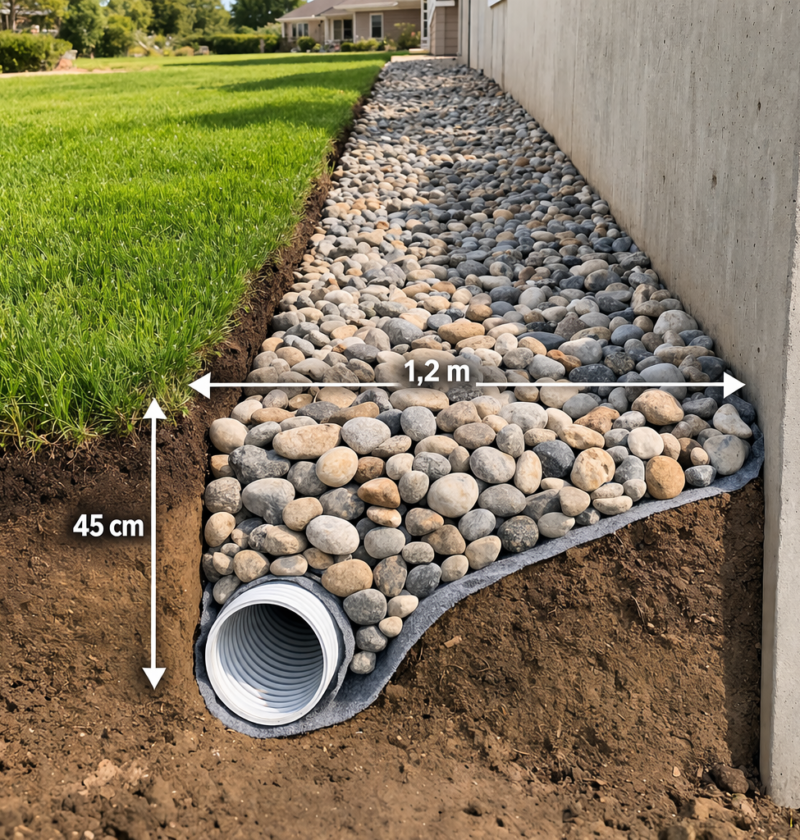
A foundation perimeter drainage system is a designed trench installed around the base of a building. Its purpose is to collect and redirect water away from the foundation before it can cause damage.
This system typically includes a combination of gravel, filtration layers, and a perforated pipe that works together to move water efficiently.
The design ensures that water follows the path of least resistance — away from the structure rather than toward it.
🔍 Key Components Explained
🧱 Perforated Drainage Pipe
This pipe is placed at the lowest point of the trench. It collects water that flows through the surrounding materials and channels it toward a safe discharge area.
🧵 Filter Fabric (Geotextile)
The geotextile layer acts as a separator between soil and gravel. It allows water to pass through while preventing fine particles from clogging the system.
🪨 River Stone Aggregate
The gravel or stone layer provides excellent drainage. It allows water to move quickly through the system while supporting the structure of the trench.
📏 Slope and Depth Design
The trench is carefully sloped so gravity can carry water toward the drainage pipe. Proper dimensions ensure the system can handle large volumes of water.
🏠 Foundation Interface
The system is installed directly along the foundation wall, creating a dry protective zone that prevents moisture buildup.
🌿 Why This System Is So Effective
The strength of this drainage system lies in its simplicity and efficiency. Instead of fighting water, it redirects it.
By replacing compact soil with permeable materials, the system allows water to move freely downward and away. This reduces pressure on the foundation and prevents long-term damage.
It also works continuously without requiring electricity or complex maintenance.