🪴 How to Build a Cardboard Garden Bed
Step 1: Prepare the Area
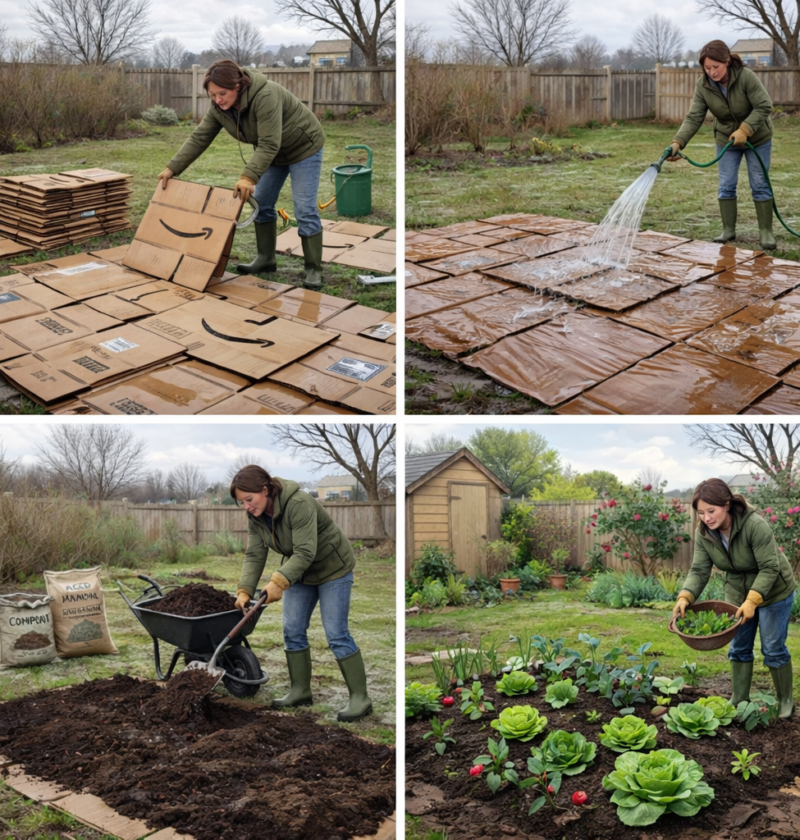
Start by clearing large debris such as rocks or branches. There is no need to remove grass or mow it extremely short.
Step 2: Lay the Cardboard
Flatten cardboard boxes and place them directly on top of the grass. Overlap the edges by at least 15 centimeters to prevent weeds from growing through gaps.
Step 3: Remove Tape and Staples
Plastic tape and metal staples do not decompose and should always be removed before placing cardboard in the garden.
Step 4: Soak the Cardboard
Use a garden hose to thoroughly soak the cardboard layer. Wet cardboard breaks down faster and stays in place more effectively.
Step 5: Add Compost
Spread 10–15 centimeters of compost, aged manure, or rich soil on top of the cardboard layer.
Step 6: Water Again
Water the entire bed once more to help settle the compost and start the decomposition process.
🌱 When Can You Start Planting?
🌿 Immediately
You can transplant seedlings directly into the compost layer as soon as the bed is built.
🌿 After 4–6 Weeks
The cardboard will soften enough for root crops like carrots or beets.
🌿 Next Season
By the following growing season, the entire cardboard layer will have decomposed into rich soil.
📦 How Much Garden Space Can Cardboard Create?
A typical household accumulates a surprising number of cardboard boxes during winter months.
Flattened and layered together, one winter’s worth of delivery boxes can easily cover around five square meters of garden space.
This area is large enough for a productive vegetable bed that can grow tomatoes, peppers, herbs, and leafy greens.
🌿 Final Thoughts
Gardening does not have to begin with heavy digging or complicated soil preparation. Sometimes the simplest solutions are also the most effective.
By reusing cardboard boxes and combining them with compost, gardeners can transform ordinary lawn space into fertile planting beds.
This technique not only saves time and effort but also recycles household materials and supports healthy soil ecosystems.
With a stack of delivery boxes, a layer of compost, and a little patience, you can create a thriving garden bed without ever picking up a shovel.