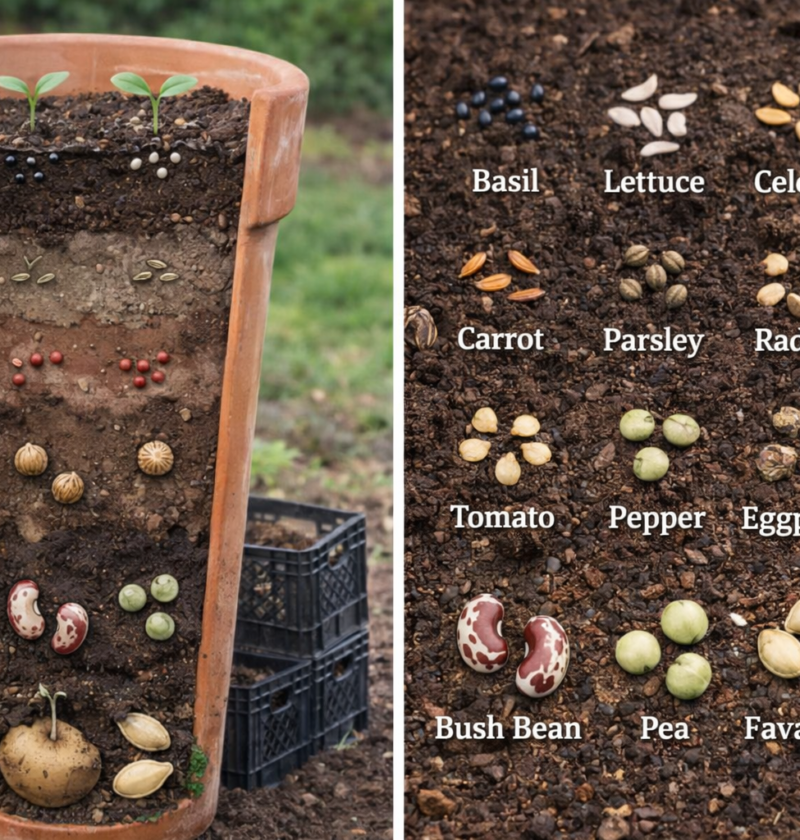
🌱 The Seed Planting Depth Guide Every Gardener Should Know for Bigger Harvests
One of the most common mistakes gardeners make is planting seeds at the wrong depth. It may seem like a small detail, but the depth at which a seed is planted can determine whether it grows into a healthy plant or struggles to emerge at all. Understanding how deep to plant seeds is one of the simplest yet most powerful gardening skills that can dramatically improve germination rates and harvest yields.
Seeds contain all the genetic information and stored energy needed to begin a plant’s life. However, they rely on the surrounding soil environment to provide the right balance of moisture, oxygen, and temperature. If a seed is planted too deep, it may run out of energy before reaching the surface. If planted too shallow, it may dry out or fail to develop strong roots.
This is why experienced gardeners always pay close attention to planting depth. By learning how deep different seeds should be planted, you can significantly increase the success of your garden and enjoy stronger plants and bigger harvests.
This guide explains the science behind seed planting depth, how soil conditions affect germination, and the recommended planting depths for many popular garden crops.
🌿 Why Planting Depth Matters So Much
When seeds begin to germinate, they rely on stored nutrients inside the seed itself. These nutrients power the initial growth that pushes the sprout toward the soil surface.
If the seed is buried too deeply, the young plant may not have enough stored energy to reach sunlight. In this case, the sprout may weaken and die before it emerges.
On the other hand, seeds planted too close to the surface may dry out quickly or become exposed to temperature fluctuations. Without adequate soil contact, they may fail to absorb enough moisture to begin germination.
The correct planting depth provides the perfect environment for the seed to absorb water, remain protected, and successfully emerge as a seedling.
🌱 The Simple Rule Most Gardeners Follow
A commonly recommended rule in gardening is to plant seeds at a depth roughly two to three times the size of the seed itself.
Small seeds require very shallow planting, while larger seeds can be planted deeper because they contain more stored energy.
This simple guideline helps gardeners estimate planting depth even when exact measurements are unavailable.
🌾 How Soil Type Affects Planting Depth
Soil texture plays an important role in determining how deep seeds should be planted. Different soil types retain moisture and air differently.
In heavy clay soil, planting seeds slightly shallower can help prevent seedlings from struggling to push through dense soil layers.
In loose sandy soil, seeds may need to be planted slightly deeper so they remain moist and stable.
Gardeners who improve their soil with compost and organic matter often create the ideal conditions for consistent seed germination.
🌱 Light vs. Darkness for Germination
Another factor influencing planting depth is whether the seed requires light or darkness to germinate.
Some seeds must remain near the soil surface because exposure to light triggers germination. These seeds should not be buried deeply.
Other seeds prefer darkness and must be covered with soil to germinate properly.
Understanding the germination preferences of different seeds helps gardeners plant them correctly.
🥕 Recommended Planting Depths for Popular Garden Crops
🥬 Lettuce
Lettuce seeds are extremely small and should be planted very close to the soil surface. Many gardeners simply press them gently into moist soil without covering them heavily.
🥕 Carrots
Carrot seeds are tiny and should be planted about ¼ inch deep. Consistent moisture is essential for successful germination.
🍅 Tomatoes
Tomato seeds are typically planted about ¼ to ½ inch deep. Warm soil temperatures help speed up germination.
🌽 Corn
Corn seeds are much larger and can be planted around 1 to 1.5 inches deep. Their larger size allows them to push through thicker soil layers.
🥒 Cucumbers
Cucumber seeds are usually planted about 1 inch deep in warm soil. They germinate quickly when temperatures are favorable.
🌱 Beans
Bean seeds are relatively large and should be planted about 1 to 2 inches deep depending on soil conditions.
🎃 Pumpkins and Squash
These large seeds are typically planted around 1 to 1.5 inches deep to support strong early growth.
💧 Watering Seeds After Planting
Proper watering is just as important as planting depth. Newly planted seeds should be watered gently to avoid disturbing the soil.
A light mist or gentle watering helps settle the soil around the seed while maintaining consistent moisture.
Seeds should remain moist but not waterlogged. Excessive water can reduce oxygen availability in the soil and harm germination.
🌞 Temperature and Germination
Temperature strongly influences seed germination. Each plant species has an optimal temperature range for sprouting.
Cool-season crops such as lettuce and spinach germinate well in cooler soil temperatures, while warm-season plants like tomatoes and peppers require warmer conditions.
Planting seeds at the correct depth helps maintain stable temperatures around the seed, improving the chances of successful germination.
🌿 Why Mastering Seed Depth Leads to Bigger Harvests
When seeds are planted at the correct depth, they germinate more consistently and produce stronger seedlings.
Healthy seedlings develop deeper root systems and stronger stems, allowing them to absorb nutrients and water more efficiently.
This early advantage continues throughout the growing season, leading to healthier plants and larger harvests.
For gardeners seeking better results, mastering seed planting depth is one of the most valuable skills to learn.
With careful attention to seed size, soil conditions, and plant requirements, gardeners can dramatically improve their success rates and grow more productive gardens.