The Complete Guide to Building and Growing an Herb Spiral
Imagine harvesting rosemary from a sun-baked hillside, mint from a cool streambank, and oregano from perfectly drained Mediterranean soil — all within arm’s reach.
No sprawling garden required.
No complicated irrigation system.
Just thoughtful design.
An herb spiral is one of the most efficient small-space garden structures ever developed. In a footprint as small as 4 to 6 square feet, it creates multiple microclimates that allow plants with very different needs to thrive side by side.
This guide will walk you through everything — from understanding the science behind the spiral to construction, soil layering, planting strategy, orientation, maintenance, seasonal care, and long-term success.
Because when structure and biology align, gardening becomes dramatically easier.
What Is an Herb Spiral?
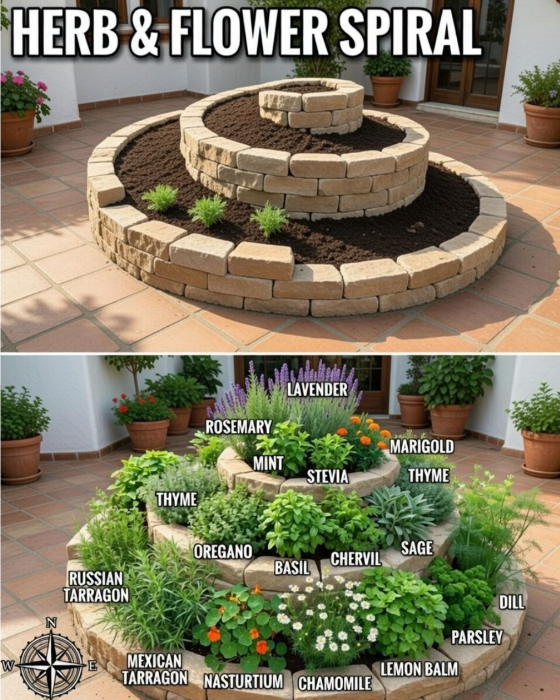
An herb spiral is a raised, spiral-shaped garden bed that gradually increases in height toward its center. Built from natural stone, brick, or other sturdy materials, it forms a coiled structure that captures sunlight, directs water flow, and creates distinct environmental zones.
The highest point — typically 2 to 3 feet tall — is warm and dry. The lowest point retains more moisture and stays cooler. The curved walls absorb heat during the day and slowly release it at night.
Instead of forcing every plant into the same soil conditions, the spiral provides variety — just like nature does.
Why the Spiral Shape Works
The design isn’t decorative — it’s functional.
1. Elevation Creates Drainage
Water naturally flows downward. The top of the spiral drains quickly, while the base retains runoff. This creates dry and moist zones without extra irrigation systems.
2. Thermal Mass Regulates Temperature
Stone walls absorb sunlight and radiate warmth into surrounding soil. This extends the growing season slightly and stabilizes temperature swings.
3. Increased Surface Area
A flat circular bed of 6 feet has one surface level. A spiral of the same footprint creates layered growing space — effectively increasing planting area without increasing square footage.
4. Microclimates in Motion
Sun angle, wind exposure, elevation, and moisture gradients combine to produce 3–4 distinct growing environments.
This is small-scale ecological engineering.
Planning Before You Build
Choose the Right Location
- Full sun (6–8 hours daily)
- Well-draining ground
- Close to kitchen for easy harvest
- Visible from multiple angles (it becomes a focal point)
Recommended Dimensions
- Diameter: 5–6 feet
- Height at center: 2–3 feet
- Path width between spiral walls: at least 12 inches
This size allows easy access from all sides without stepping on soil.
Materials You’ll Need
- Natural stone, brick, or concrete block
- Gravel (optional, for base drainage)
- High-quality garden soil
- Compost
- Coarse sand (for top dry zones)
- Mulch
- Shovel and level
Natural stone is ideal because it allows slight air exchange and provides strong thermal mass.
Step-by-Step Construction
Step 1: Mark the Spiral
Place a stake at the center. Use string or rope to outline a spiral shape extending outward. The spiral should widen gradually from center to base.
Step 2: Prepare the Ground
Remove grass and loosen the soil beneath the footprint. Level gently but allow slight natural slope if present.
Step 3: Lay the Base Layer
If drainage is poor, add a shallow layer of gravel. This prevents waterlogging at the bottom zone.
Step 4: Stack Stones Gradually
Begin forming the outer spiral wall first. Stack stones securely without mortar (dry stack is fine for most home builds).
As the spiral curves inward, increase wall height gradually toward the center.
Step 5: Backfill as You Build
Add soil as walls rise to prevent collapse and settling. Tamp lightly but do not compact excessively.
Step 6: Shape the Summit
The center peak should be the highest and driest point. Mix additional sand into soil at this top tier to enhance drainage.
Soil Composition by Zone
Top Tier (Hot & Dry)
- 40% garden soil
- 30% compost
- 30% coarse sand or grit
This ensures sharp drainage for Mediterranean herbs.
Middle Tiers (Moderate)
- 60% garden soil
- 40% compost
Balanced moisture retention and airflow.
Base Level (Cool & Moist)
- 70% soil
- 30–40% compost
Rich and slightly denser to hold moisture longer.
Planting by Microclimate Zone
Top Tier — Sun & Excellent Drainage
- Rosemary
- Thyme
- Lavender
- Sage
These plants originate from Mediterranean climates and require dry roots and full sun.
Middle Tier — Moderate Conditions
- Oregano
- Chamomile
- Tarragon
- Dill
These tolerate moderate moisture but dislike soggy soil.
Base Tier — Cool & Moist
- Mint
- Parsley
- Lemon Balm
- Chervil
- Basil
These appreciate richer soil and steady hydration.