Seed Planting Depth Guide: How Deep to Sow for Strong Germination
Planting seeds at the right depth can mean the difference between:
- Strong, uniform germination 🌱
- Or seeds that dry out, rot, or exhaust themselves before reaching light
The golden rule is simple:
Plant seeds at a depth of 2 to 3 times their thickness.
Large seeds go deeper. Tiny seeds stay close to the surface.
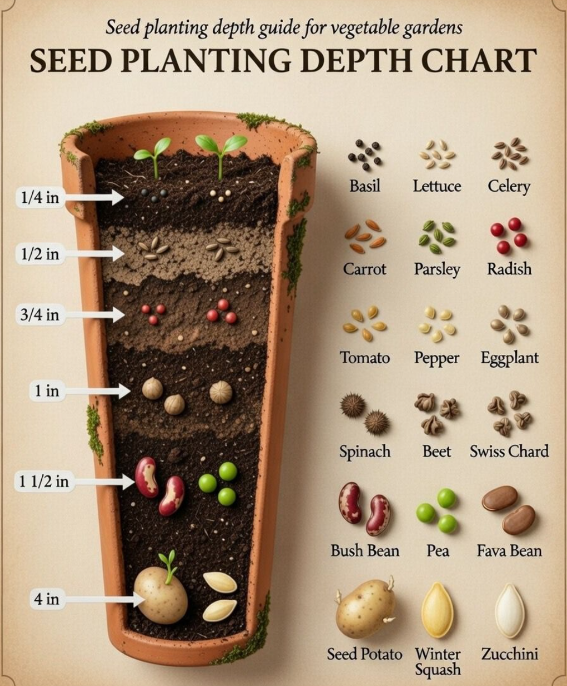
Below is a practical depth guide for common garden crops — so you can sow confidently and get stronger results.
🌤 Barely Covered (About 1/4 Inch or Surface-Sown)
These seeds are tiny and often need light to germinate. Do not bury deeply.
Basil
- Press lightly into soil surface
- Do not bury deeply
- Keep evenly moist
Lettuce
- Light-dependent germination
- Sprinkle on surface and tamp gently
- Thin seedlings once established
Celery
- Very slow to sprout (15–20 days)
- Keep consistently moist
- Benefits from a humidity dome during germination
🌱 1/2 Inch Deep
Small but sturdy seeds that need a light soil covering.
Carrot
- Mix seeds with sand for even spacing
- Germinates in 10–15 days
- Keep surface consistently moist
Parsley
- Very slow (3–4 weeks)
- Do not give up too soon
Radish
- Fastest garden crop
- Sprouts in 4–5 days
- Ready to harvest in about 25 days
🌿 3/4 Inch Deep
Medium seeds that need warmth and steady moisture.
Tomato
- Start indoors 6–8 weeks before last frost
- Needs at least 68°F (20°C) to germinate
- Sprouts in 7–10 days
Pepper
- Requires consistent warmth
- Do not let soil drop below 65°F (18°C)
- Germinates in 10–15 days
Eggplant
- Slowest of the nightshades
- 12–18 days to sprout
- Ideal temperature around 77°F (25°C)
Pages: 1 2