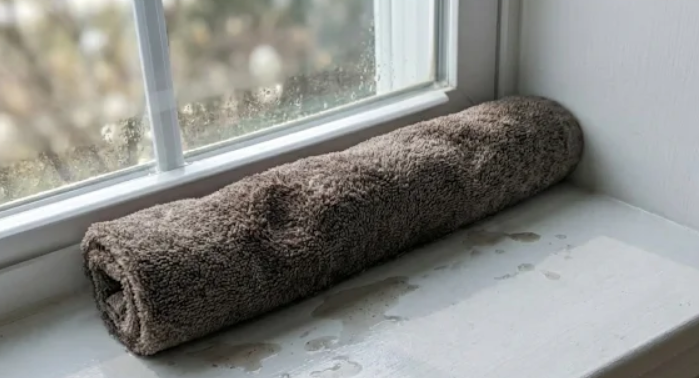
How Much Cooling Can You Expect?
Let’s be realistic.
The damp towel trick will not lower your entire room temperature by 10 degrees. It’s not a replacement for air conditioning.
At best, under dry conditions, you might experience:
- A slight drop in incoming air temperature
- A cooler breeze near the window
- Improved comfort if positioned nearby
The effect is typically localized rather than room-wide.
When It Works Best
This method is most effective when:
- You live in a dry climate
- Nighttime temperatures drop significantly
- There’s a gentle breeze
- The humidity is low
- You position yourself near the airflow
Desert or semi-arid regions are ideal environments for evaporative cooling techniques.
When It Won’t Help (And Might Make Things Worse)
The trick is unlikely to work well if:
- The air outside is humid
- There is no airflow
- The outdoor temperature is still extremely high at night
- Your room already feels damp or sticky
Adding moisture to already humid air can make it feel warmer, not cooler.
How to Maximize the Effect
If you want to try it, here are some practical tips:
- Use a thin towel to increase airflow contact.
- Wring it thoroughly — damp, not dripping.
- Place a small fan behind or near the towel to increase air movement.
- Ensure cross-ventilation by opening another window if possible.
- Replace or re-wet the towel as it dries.
A fan-assisted version works much better than passive airflow alone.
Comparison: Damp Towel vs. Evaporative Cooler
| Feature | Damp Towel | Evaporative Cooler |
|---|---|---|
| Airflow Control | Minimal | Powered fan system |
| Water Distribution | Single towel surface | Engineered cooling pads |
| Cooling Strength | Localized, mild | Whole-room potential |
| Best Climate | Dry | Dry |
The towel method is essentially a simplified, low-efficiency version of a swamp cooler.
Other Low-Tech Cooling Tips
If you’re avoiding air conditioning, consider combining methods:
- Close blinds during the day to block solar heat gain.
- Open windows only when outdoor air is cooler than indoor air.
- Use cross-breezes strategically.
- Sleep with breathable cotton sheets.
- Place a bowl of ice in front of a fan for short-term spot cooling.
Cooling strategies are often most effective when layered.
The Verdict: Science, With Limits
The damp towel trick is not a myth.
It is grounded in real thermodynamics.
But it is also limited.
In dry conditions with airflow, it can provide modest, localized cooling. In humid environments, it does very little.
It won’t transform your bedroom into an air-conditioned oasis.
But under the right circumstances, it might just take the edge off — enough to help you drift toward sleep.
Sometimes the oldest tricks endure because they’re simple, low-cost, and rooted in real science.
Just remember:
Humidity decides whether it’s clever — or pointless.