🌷 Egg Carton Method for Mass Bulb Planting — A Brilliant Kitchen Hack for Effortless Flower Beds
Planting spring bulbs can be one of the most rewarding parts of gardening — until you consider digging fifty, a hundred, or even more individual holes! What if there were a way to plant hundreds of bulbs in a fraction of the time, with perfect spacing every single time and without back‑breaking work?
Enter the **Egg Carton Method** — a clever and surprisingly effective technique that takes advantage of simple materials you probably already have. This method dramatically speeds up planting, guarantees even spacing, and helps your bulbs establish roots faster. Whether you’re planting tulips, daffodils, crocus, or grape hyacinths, this strategy will save your knees, your time, and your energy.
In this comprehensive guide, we’ll walk you through every step of the Egg Carton Method, explain when and how to use it, discuss the best bulbs for this technique, offer expert tips, and help you avoid common mistakes. By the end, you’ll be ready to plant a spectacular spring display with ease.
🌱 Why the Egg Carton Method Works — And Why Gardeners Love It
Traditional bulb planting often involves digging many individual holes spaced precisely, measuring twice, bending over a lot, and making repetitive motions. The Egg Carton Method flips that process on its head by letting you work more efficiently in larger sections.
This method works because:
- 📏 It ensures **consistent spacing** between bulbs based on the size of your cartons.
- 🪣 It allows you to plant dozens of bulbs at once with one trench and one pass of backfilling.
- 📦 The cardboard slowly breaks down in the soil, enabling roots to grow through naturally.
- 💦 It promotes better water distribution around bulbs during establishment.
Gardeners who have used this method report bulbs establishing quickly and emerging as a uniform “carpet” of blooms in spring — without the usual sore back or hours of repetitive digging.
📅 When to Use the Egg Carton Method (Optimal Planting Window)
Spring‑flowering bulbs require a period of cold soil to trigger proper root growth. For most climates, this means planting in the **fall**, after soil temperatures drop below about 60°F (15°C) but long before the ground freezes.
Planting in this window allows bulbs to:
- Develop strong root systems before winter.
- Become established so they can support vigorous top growth in spring.
- Break dormancy naturally with temperature changes.
If you plant too early when soil is still warm, bulbs may rot or sprout prematurely. Too late and they might not develop sufficient roots before winter sets in. In many regions, mid‑September through early November is ideal, though exact timing depends on local climate.
🌾 Materials You’ll Need (What Works Best)
Gather the following before you begin:
- 📦 Paper pulp or cardboard egg cartons — NOT Styrofoam or plastic.
- 🔪 A small utility knife or scissors.
- 🔍 Your chosen spring bulbs (see best options below).
- 🧤 Gloves for handling soil and bulbs.
- 💧 Water source for deep watering after planting.
- ⛏️ A garden fork or shovel for digging a trench.
The key material is cardboard — it should be free of inks, glossy coatings, tape, or staples, and fully biodegradable. Paper pulp cartons break down quickly in the soil, creating a natural environment for roots to spread.
🔧 Step‑by‑Step: How to Use the Egg Carton Method
Follow this detailed process for best results:
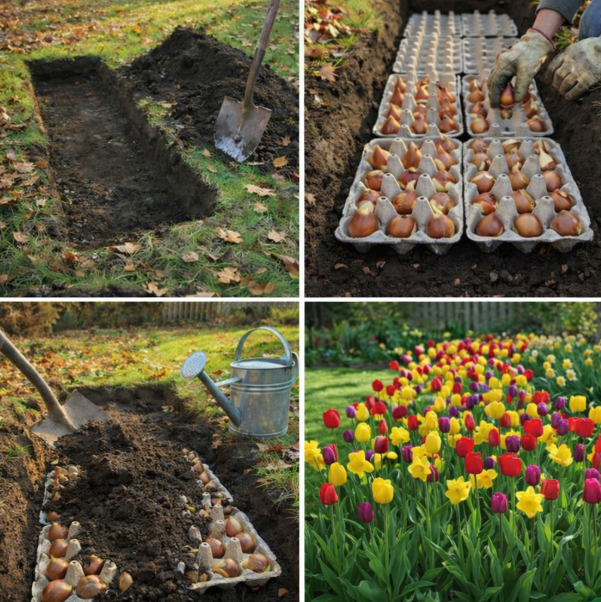
Step 1 — Dig One Large Trench
Stop digging fifty individual holes! Instead:
- Use a shovel or garden fork to dig a single long trench.
- The depth should be about 3× the height of the bulb (e.g., if bulbs are 2 inches tall, dig ~6 inches deep).
- Make the bottom of the trench flat and level so bulbs sit evenly.
This trench becomes your planting area. It can be straight or curved depending on your garden design.
Step 2 — Prepare and Place Egg Cartons
Lay cardboard egg cartons **side‑by‑side** directly on the level soil at the bottom of your trench. Place one bulb in each egg cell, **pointy end up**.
Before placing bulbs, use a small knife or scissors to:
- ✔ Cut a small slit in the bottom of each egg cup so bulb roots can penetrate the soil more quickly.
- ✔ Ensure the carton cups sit flush with the soil (no tilted cartons).
The bulb cups in the carton naturally space bulbs evenly, reducing guesswork and measurement time.
Step 3 — Backfill the Trench
Use the soil you excavated to fill in the trench and cover the bulbs:
- Backfill until you’ve covered the **bulb tips with about 4–6 inches of soil**.
- Firm the soil gently to eliminate air pockets.
As you backfill and water, the cardboard begins to absorb moisture and start decomposing — a helpful phase that allows roots to spread through the carton walls.
Step 4 — Water Deeply and Let Nature Work
Once the trench is filled:
- Give the entire area a **deep watering** to settle the soil.
- Keep the soil moist (not soggy) through fall and early winter as bulbs establish roots.
- The cardboard continues breaking down over time and will be gone by spring.
By the time bulbs sprout above ground, the cartons will have decomposed completely — leaving a perfectly spaced carpet of growth beneath your flowerbed.
🌷 Best Bulbs for the Egg Carton Method
Not all bulbs are created equal when it comes to this method. Some fit perfectly in egg carton cells, while others are too large and need extra room.
- 🌼 Perfect fit — Tulips, daffodils (narcissus), crocus, grape hyacinth (muscari), scilla.
- ⚪ Too large — Giant alliums and other oversized bulbs that need more spacing than egg cups can provide.
The bulbs listed as “perfect fit” are typically small to medium in size and thrive with the spacing egg cartons provide. Larger bulbs should be planted with traditional spacing or with modified cardboard layouts that allow more room.
🎯 Why Cardboard Matters — And Why Not Plastic or Styrofoam
Only use paper pulp or cardboard cartons in this method.
Here’s why:
- 📦 Cardboard is biodegradable and breaks down in soil, allowing roots to grow through naturally.
- 💧 It holds moisture briefly, aiding root establishment without creating soggy conditions.
- 🌿 It adds organic matter to the soil as it decomposes.
⚠️ Avoid Styrofoam or plastic cartons! These materials do not decompose and will block bulb roots, potentially harming growth and creating long‑term waste in your garden.
🌞 Post‑Planting Care Tips for Bulbs Planted With the Egg Carton Method
Once planted and watered, bulbs don’t require much attention — but a few care tips will help maximize blooms:
Watering Through Fall and Winter
Keep the soil evenly moist (not wet) after planting to support root development. Once winter temperatures set in, you’ll water less frequently, as bulbs become dormant during cold months.
Mulching for Stability
A light layer of mulch (like shredded leaves or straw) helps regulate soil temperature and moisture, protecting roots throughout winter.
Watching for Spring Growth
As soil warms in spring, shoots will emerge evenly thanks to the carton spacing. At this point, continue regular watering and enjoy the blooms!
🌱 Expert Insights on Mass Bulb Planting Techniques
🌼 Master Gardener Olivia Kingston
“This method transforms spring bulb planting. Traditional individual hole planting is time‑consuming and often results in uneven spacing. Egg cartons simplify spacing and literally plant hundreds of bulbs in the time it once took to plant a dozen.”
🌻 Horticulture Educator Dr. Lucas Hernandez
“Cardboard decomposition aligns well with bulb root growth cycles. By the time shoots emerge, roots have already spread into surrounding soil — a perfect transition.”
🌼 Landscape Designer Mia Sharma
“For large beds or borders, this technique is a game changer. You can maintain design integrity, spacing accuracy, and save your back all in one strategy.”
📌 Common Mistakes to Avoid With This Method
Even a great technique can be less effective if misused. Here are pitfalls to watch out for:
- ❌ Using plastic or Styrofoam cartons — these do not break down and will interfere with root growth.
- ❌ Cutting cartons too late — prepare them before you start digging for efficiency.
- ❌ Skipping deep watering after planting — water helps settle soil and kick‑start root development.
- ❌ Planting when soil is too warm — wait until soil temperatures have dropped.
- ❌ Forgetting to cut slits in carton bottoms — this can slow root penetration into soil.
❓ Frequently Asked Questions (FAQs)
1. Can I use this method if my soil is heavy clay?
Yes! The egg carton strategy works in clay soils as long as you improve drainage with organic matter and backfill properly to avoid waterlogging.
2. Do I need to remove the cardboard in spring?
No — it should decompose fully and won’t harm plants. Removing it prematurely can disturb roots.
3. How close should the cartons be placed?
Side‑by‑side without gaps ensures uniform spacing. If your trench is wider than your carton row, you can place multiple rows.
4. Can I plant bulbs deeper than the carton level?
Yes — as long as the total soil depth above bulbs is about 3× bulb height. Adjust trench depth accordingly.
5. What if cardboard gets soggy before I plant?
Soggy cardboard is still usable but handle gently to avoid tearing. Plant soon after preparing cartons if possible.
6. Can I use this for container bulb planting?
Yes — lay cut‑to‑fit cardboard trays in the bottom of your container, place bulbs in the cells, then backfill. Ensure excellent drainage.
7. Will this work for bulbs planted on a slope?
It can. Dig a stepped or terraced trench to prevent soil wash. Mulch helps too.
8. What if cartons shift before backfilling?
Press them gently into the trench bottom to secure them, then backfill carefully.
9. Can I paint or coat cartons to make them stronger?
No — coatings or paints interfere with biodegradation. Use them as‑is.
10. Does this method attract pests?
Cardboard itself doesn’t attract pests if planted properly. Proper watering and soil health reduce pest issues overall.
🌸 Conclusion: A Smarter Way to Plant Bulbs
The Egg Carton Method for mass bulb planting offers gardeners a clever, efficient, and effective alternative to traditional individual hole planting. By using simple, biodegradable materials, maintaining proper spacing, and following smart planting steps, you can create breathtaking spring displays with far less effort.
Whether you’re a seasoned gardener or a beginner, this strategy will save you time, protect your back, and deliver uniform, reliable results season after season. With proper timing, the right materials, and a bit of planning, you’ll be enjoying a perfectly spaced carpet of blooms every spring — all thanks to a kitchen‑friendly gardening hack.
Happy planting! 🌷